
Balancing a global operation with a warming climate

Working in a research space punctuated by climate change, we're all too aware of the impact international travel has on the planet. Reducing our carbon footprint while doing jobs that demand global collaboration takes constant consideration, much of which falls onto the dedicated Policy and Environment Team at Antarctica New Zealand.
General Manager for Policy and Environment, Ceisha Poirot says, "Attending conferences such as SCAR earlier this month is an investment in the science-policy interface, ensuring Antarctic decisionmakers have access to the latest research needed to protect Antarctica's environment and understand its influence on the global climate system."
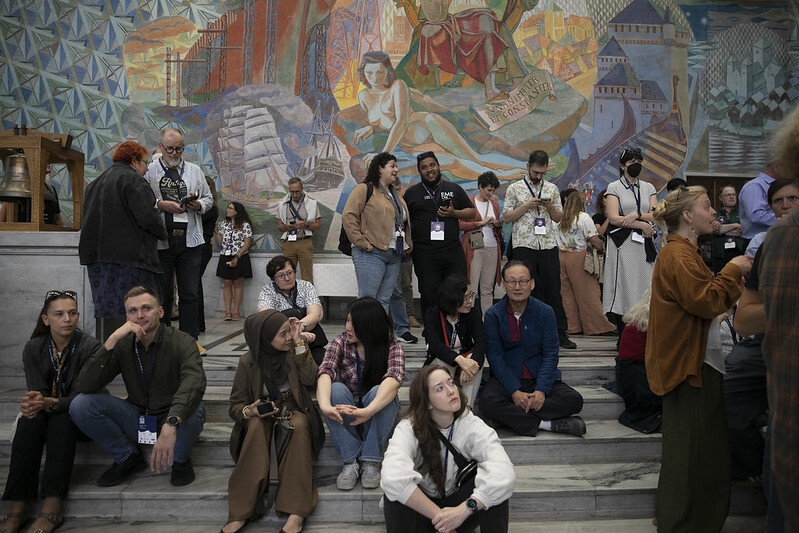
During the SCAR Open Science Conference in Norway, Ceisha was a workshop panel member and co-convened a parallel session titled Pathways to polar decarbonization: How can Antarctic research operations lead the way?
Joining her was Reporting and Data Advisor Alex Aves, who led three workshops on Antarctic governance and science-based decision-making; early career engagement and priorities in IPY-5 and Antarctica InSync; and plastics in the polar regions. Alex has recently joined Antarctica New Zealand, and says the conference provided a valuable opportunity to establish new connections and develop an understanding of the wider context of her role.
While Senior Environmental Advisor Natasha Gardiner opted to stay in Aotearoa, she remotely co-convened a SCAR workshop on impactful conservation research.
Carbon-friendly policies
Antarctica New Zealand's Environmental Manager Sophia White says travel is one of the trickiest areas of mitigation when it comes to our environmental footprint.
"We encourage all our staff to travel by public transport or carpool while they're at events," she says, "or make sure their accommodation is close to the venue so they can walk."
With long journeys, most staff make sure to organise their calendar so they can attend multiple events in a row, or add on a holiday after their mahi (work).
They're also encouraged to consider the need for travel in the first place - in a post-covid era, conducting team hui and initial job interviews online can get the job done just as well.
"We're part of the Carbon Neutral Government Programme (CNPG)," Sophia explains, "which was set up to help the public sector reduce their emissions faster in 2021. However, we've been monitoring our carbon footprint with Toitū Envirocare for the past 18 years."
She says it's a good sign that, despite the scope of our operations expanding dramatically, our carbon footprint has decreased against our base-year (2015-16), and emissions per full-time employee (FTE) has reduced substantially (159.6tCO2e/FTE in 2015-16 to 53.49tCO2e/FTE in 2025-26).
To try and make the trend even better, we’ve started looking at some creative solutions, such as implementing a meat-free day each week at Scott Base and the Workride Plus scheme, which enables employees to purchase bikes or e-bikes through salary sacrifice. The purchase of meat is our 9th highest emission source and staff commuting is our 11th .
Antarctica New Zealand has also recently approved an updated Emissions Management and Reduction Plan. Our biggest projects that will impact our footprint are the upgrade to the wind farm and the redevelopment of Scott Base. The windfarm will increase the renewable energy generation from 1MW to 3MW and the electrification of the Scott Base infrastructure is estimated to reduce emissions substantially over the life of the project.
The benefits of these will only be fully realised upon completion, around 2030, however, we will continue to focus on projects that encourage reductions in areas that are hard to decarbonise:
- Working with internal and external stakeholders to ship cargo instead of flying it to Antarctica
- Reducing emissions from organisational air travel
- Trialing renewable energy in field camp sites